New genomic method to track disease outbreaks globally
Phylo-Plex, a new computational method, has been developed by Wellcome Sanger Institute scientists and their collaborators to allow cost-effective and scalable DNA sequencing of pathogens in laboratories with limited resources.
Published today (9 July) in Nature Communications, Phylo-Plex analyses genetic information from deadly pathogens to help track disease outbreaks, monitor antibiotic resistance and build capacity for research into how infections are spread.
Genomic surveillance of viral, bacterial and fungal pathogens has proven to be a powerful tool for both public health and research. However, whole genome sequencing is expensive and technically complex, and for certain pathogens it is particularly difficult. For example, the bacterium that causes syphilis, Treponema pallidum, is difficult to grow in the lab because it has complex nutritional and environmental requirements. Sequencing of its entire genome also often requires expensive methods.1
Therefore, in places with limited resources, sequencing pathogens at scale can be difficult due to costs, availability of equipment and complexity of data analysis, especially when pathogens cannot be easily cultured.
To help resolve this problem, scientists at the Sanger Institute and their collaborators in Zimbabwe and South Africa developed ‘Phylo-Plex’ — a more accessible and affordable sequencing method. Instead of sequencing the whole genome, this approach works by analysing existing genome data from many samples to find the most informative parts of the genome — the points where changes in DNA distinguish one bacterial strain from another.
Phylo-Plex then designs primers, short pieces of DNA, that act as a starting point for DNA synthesis. This enables researchers to focus on and sequence only these regions of the genome.2 This approach allows the capturing of key genetic differences while actually sequencing only a small fraction of the genome.
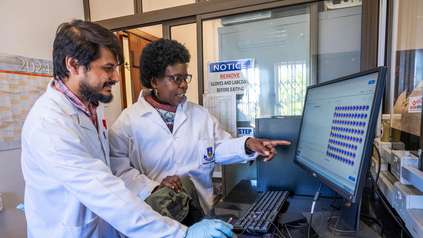
Using Treponema pallidum as a model, the researchers successfully deployed the method in a low-resource laboratory in Harare, Zimbabwe. Coupled with low-cost nanopore sequencing, which is a portable and scalable DNA sequencer,3 they found the approach provides a fast and flexible framework for sequencing and analysis.
The Phylo-Plex method currently costs approximately £12.47 per sample — with room for further cost reduction — which is significantly less than conventional sequencing methods, that typically range from £28 to £112 per sample. The method can also run in small batches and gives results in one to two days, allowing researchers to rapidly investigate emerging outbreaks as they are happening as well as more long-term surveillance studies.
The research demonstrates that Phylo-Plex enables low-cost tracking of closely related bacterial strains. The team is now collaborating with partners in Cameroon to apply the approach to antimicrobial resistance studies in Escherichia coli.
By testing out the method in other countries and across multiple bacterial species, the researchers hope that it will help strengthen research capacity in resource-limited settings. Its fast, flexible and scalable nature makes it well suited for laboratories that need affordable methods to monitor infection and disease.
“Genomic surveillance in low-income countries has been a long-standing problem. We want to help researchers in these countries to overcome barriers to science. With Phylo-Plex researchers will be able to carry out genome sequencing and analysis of prolific bacterial DNA, with the potential to open up continent-wide, low-cost surveillance of major infectious disease threats without compromising the resolution achieved by existing approaches.”
Dr Mathew Beale, first author at the Wellcome Sanger Institute
“We were very pleased to test Phylo-Plex in Zimbabwe. We found that we can sequence and extract key genetic information from the Treponema pallidum bacterium, which is a pathogen that can cause deadly infections. We now want to train researchers how to use the method in different countries and with various other bacterial strains in order to strengthen research capacity across whole continents.”
Professor Rashida Ferrand, co-author at the London School of Hygiene and Tropical Medicine and the Biomedical Research and Training Institute in Zimbabwe
More information
Notes to Editors
- These bacteria cannot be easily cultured so researchers must sequence directly from clinical swabs. However, most DNA in a swab is human DNA and the pathogen may represent as little as 0.01 per cent of total DNA.
- Bacterial genomes are large, usually more than one million bases long. Capturing entire bacterial genomes with multiplex PCR – the method used for much shorter viral genomes – would require too many primers and is not technically feasible in low-resource countries.
- A nanopore sequencer is a real-time DNA/RNA sequencing technology that identifies molecules by passing them through a nanoscale pore (nanopore) embedded in a membrane. It measures changes in ionic current to determine base sequences without synthesizing DNA and is portable and scalable.
Publication
M. Beale et al. (2026) ‘A phylogenetically informed, low-cost amplicon sequencing platform for deployable high-resolution genomic epidemiology’. Nature Communications. DOI: 10.1038/s41467-026-75002-y
Funding
This research was supported in part by the Gates Foundation and Wellcome. A full list of acknowledgements can be found in the publication.