Evolution has reused the same genes for 120 million years
The international team includes experts at the Wellcome Sanger Institute, University of York, Universidad Regional Amazónica Ikiam in Ecuador, and others.
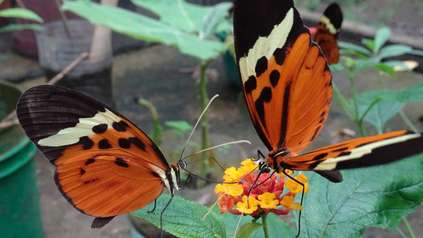
The research, published today (30 April) in PLOS Biology, studied several distantly related butterfly and moth species from the South American rainforest. These species exhibit strikingly similar wing colour patterns to warn predators of their toxicity, a phenomenon known as mimicry.
The study found that despite being very distantly related, these various species reused the same two genes − ivory and optix − to evolve nearly identical warning patterns. Interestingly, the genetic changes did not occur within the genes themselves, but rather in similar ‘switches’ that control how the genes are turned on or off. The moth species in the study used an inversion mechanism, where a large section of DNA is flipped backwards, a near identical genetic trick used by one of the butterflies.
The findings suggest that evolution is not always a roll of the dice but follows certain pathways. Understanding that nature follows these specific routes helps scientists better predict how species might adapt to environmental shifts or climate change.
“Not only did we find an association between a gene and colour variation in various species, but we also showed that breaking that gene through genetic modification actually changes the butterfly’s colour from orange/black to yellow. Additionally, our work revealed that expression of the gene of interest predicts the adult butterfly’s wing colour pattern while the butterfly is still forming its wings in the chrysalis. This confirms our association analysis identified the correct gene.
Co-first author at the Wellcome Sanger Institute and the University of Cambridge
“Convergent evolution, where many unrelated species independently evolve the same trait, is common across the tree of life. But we rarely have the opportunity to investigate the genetic basis of this phenomenon. Investigating seven butterfly lineages and a day-flying moth, we show that evolution can be surprisingly predictable, and that butterflies and moths have been using the exact same genetic tricks repeatedly to achieve similar colour patterns since the age of the dinosaurs.”
Professor Kanchon Dasmahapatra
Senior author from the University of York
“These distantly related butterflies and the moth are all toxic and distasteful to birds trying to eat them. They look very much alike because if birds have already learned that a specific colour pattern means “do not eat, we are toxic”, it is beneficial for other species to display the same warning colours.
“Here, we show that these warning colours are particularly ideal as it seems quite easy to evolve these same colour patterns due to the highly conserved genetic basis over 120 million years.”
Senior author at the Wellcome Sanger Institute and the University of Cambridge
More information
More information:
This study was made possible by a large international collaboration. As well as those already mentioned, this work included researchers at the University of Sheffield, UK, the University of Cambridge, UK, the University of Miami, USA, Harvard University, USA, Universidad Regional Amazónica IKIAM, Ecuador, Universidad Nacional Mayor de San Marcos, Peru, Université de Guyane, France, Universidad del Rosario, Colombia, Muséum National d’Histoire Naturelle, France, Collège de France, and the Smithsonian Tropical Research Institute, Panama. A full list of contributors and affiliations can be found in the publication.
Publication:
Y.C. Chehida, E.S.M. van der Heijden, et al. (2026) ‘Genetic parallelism underpins convergent mimicry coloration in Lepidoptera across 120 million years of evolution.’ PLOS Biology. DOI: 10.1371/journal.pbio.3003742
Funding:
This research was supported by the Wellcome Sanger Institute and University of York.