Collaboration, code and community at Sanger Institue
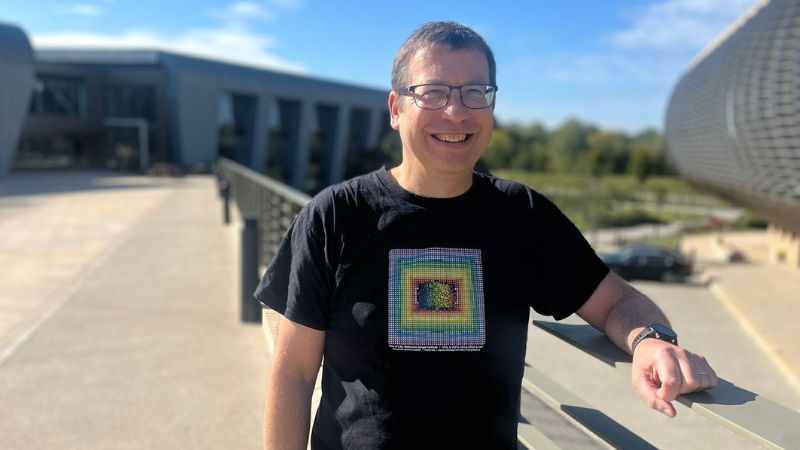
Andrew has been at the Sanger Institute for five years. He joined as a Principal Full stack Software Developer and was lucky enough to move on to lead the team as it grew. Today, as Head of Software Development in the Tree of Life programme, Andrew leads a team of talented software developers building production software that powers our large scale biodiversity genomics projects.
“As well as being involved with the architecture and coding of our projects, my role includes recruitment, mentoring and liaising with scientists and project managers,” he explains. “Probably my favourite part of the role is working with early career developers and helping them to grow in skills and confidence and learning lots from them in the process.”
The Tree of Life software team develops both internal and external facing, data rich web applications.
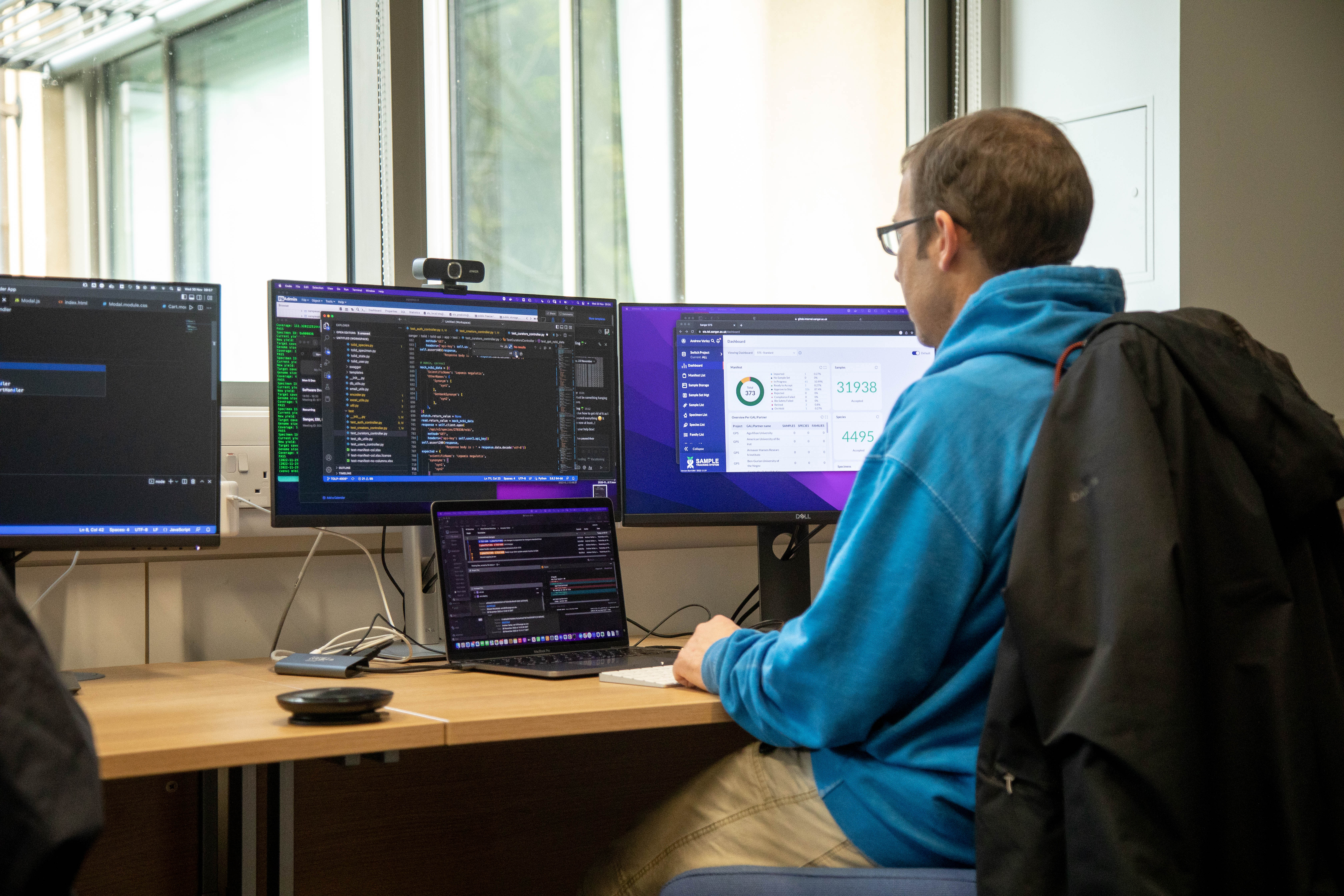
“Our internal facing software helps scientists to keep track of the many thousands of samples we onboard into the programme as they pass through legal and regulatory compliance and arrive on site,” Andrew says. “Our scientists and project managers need to see all available data for their projects and samples, as the data are being produced, so we have built a data aggregation and visualisation system which we call the ToL Portal so that they can see all available data in one place.”
This aggregated data also drives partner facing websites, allowing collaborators to explore and download the data produced by the programme.
Upcoming projects include:
- A publishing platform for Genome Notes, short publications describing how each genome has been produced, from collection through the lab to assembly and curation.
- A web app to support the biodiversity education initiative, the Biodiversity Genomics Academy.
- The team is about to start work on a new mobile app to assist collectors in the field collect samples for the Tree of Life programme, connecting them to up-to-date information of what species we still need and recording metadata, such as photos and GPS coordinates, immediately.
“We are always working on improvements to our existing software and encourage developers to work on new features they would like to see,” Andrew adds. “In fact, some of our most exciting features have originated from developers’ own initiatives.”
Making science easier
Software development is central to delivering Sanger Institute’s scientific mission.
“We are producing data at scale, across many different platforms, which means that it is not feasible to keep track of data on spreadsheets,” Andrew explains. “Whilst we do make use of some commercial software, many things we do are novel, so need software to be developed to support these activities and, for example, integrate between systems.”
Since the launch of the ToL Portal, scientists have saved many hours previously spent manually tracking their data in different systems, freeing them up to concentrate on their science.
“When we know that some of our software has made someone’s life easier, that makes us happy.”
Technologies and teamwork
The team’s main languages are Python and Typescript.
“Python is a mature and powerful language that we use for building our backend APIs. Typescript is used for building our modern web user interfaces,” Andrew says. “We are lucky at Sanger Institute to have our own data centre and private cloud infrastructure, so all our software is deployed to a Kubernetes cluster running there.”
Across the wider institute, you will also find software written in C, Perl, Ruby, R and Rust.
Collaboration is constant.
“It’s really important that the software we develop is exactly what people need and expect, and that we deliver value for them all the time,” Andrew explains. The team works in three week sprints, planning in collaboration with scientists and other stakeholders. At the end of each sprint, they hold a review session to demonstrate and discuss what they have done before planning the next phase of work.
A place to grow
There are many routes into and through software development at Sanger Institute.
Roles range from full stack developers working across backend, frontend, data and DevOps, to more specialised positions. Depending on the team, developers might focus on algorithm development and compute performance, or take a more data or DevOps focused path.
Career progression does not stop at senior developer roles either. Developers can move into positions with more responsibility for projects and people, or transition into other job families such as project management or bioinformatics and data analysis.
Andrew is particularly passionate about early career pathways. “I am a huge fan of degree apprenticeships and we have two apprentices in my team at the moment,” he says. “Apprentices study one day a week but are part of the team for the rest of the week.” Logan joined the team three years ago straight from A levels. “He has been fantastic. People are shocked when they realise he is still an apprentice.”
The Institute’s Technical Talent Scheme places graduates into software teams across the organisation, with many going on to secure permanent roles. Andrew highlights Luke, now working on front end projects in his team, and Ene, who moved from software development into data analysis.
Professional development is actively encouraged.
“There are many opportunities in the institute for professional development and we encourage software developers to make use of these,” Andrew says. Developers have access to learning platforms such as LinkedIn Learning and can attend training and certification courses, such as Scrum, to support their growth.
Examples include:
- The Accelerating Talent Programme, where participants work on institute wide projects including AI adoption initiatives.
- Formal mentoring through the institute wide scheme, alongside informal mentoring within teams.
- Andrew also helped establish a community of practice for software developers across the institute.
“Software development is going on in many teams across the institute, which is good because it allows developers to be close to their users, but also means that some developers can be isolated,” he explains.
The community meets every eight weeks for talks, refreshments and discussion. It is also a welcoming space for early career developers to give short presentations in a friendly setting. Recent cross programme collaboration has simplified integration with a commercial lab notebook platform, which has been a win win for both teams.
Life beyond the code
Team culture matters. In Andrew’s team, there is a breakfast every three weeks, part social and part technical discussion. “We might, for example, discuss something that is annoying us with our software and what we will do as a team to make it better.”
Being part of a scientific programme also means joining in wider socials, from coffee before weekly seminars to picnics and Olympics on the playing field.
Across the full stack software community, hackathons are held a couple of times a year. In January, developers worked on new features for the ToL Portal to make it easier for other areas to adopt. In September, they worked to modernize some older yet essential software used across the Institute.
For Andrew, what makes Sanger Institute unique is its immediate impact.
“It is the buzz of seeing software we write being used by scientists and knowing that our software is making a difference, solving a problem, making someone’s job easier,” he says. “Software developers here are near to the science and what we develop one day can be used in a production setting the next.”
Beyond work, there is plenty happening on campus, from clubs and classes to sports facilities and informal networks, creating a strong sense of community.
What Andrew looks for in new hires
“The main skills are teamwork and problem solving skills, as well as an enthusiasm for wanting to be a software developer,” Andrew says.
Apprentices or new graduates might not yet have experience in a formal work setting, but can demonstrate skills through sports teams, Scouts or other activities. For more senior roles, technical and leadership experience are key.
With a high volume of applications, Andrew advises candidates to:
- Clearly demonstrate how they meet the essential criteria in the job description.
- Use their covering letter to make this alignment explicit.
- Keep their CV comprehensive but concise, two pages maximum.
- Do some research on the role and the team before applying.
“Working in a research institute as a software developer is enjoyable and you can clearly see your work making a difference,” Andrew says.
It is a fast moving environment, and software developers need to be adaptable and open to learning new skills. But software development, as well as many other job families at Sanger Institute, builds highly transferable skills that are valued across industries.
For Andrew, leading a team is not just about delivering software. It is about creating an environment where developers can grow, collaborate and see the real world impact of their work.