

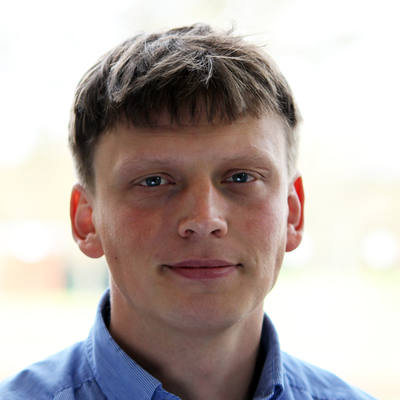
Alumni
This person is a member of Sanger Institute Alumni.
Leo’s team developed wetlab and computational methods for understanding variation in human gene function. They worked on predicting CRISPR-Cas editing outcomes, methods for large-scale CRISPR, CRISPRi, and prime editing screening, measuring gene function variation across individuals, and creating large-scale variation using prime editing and recombinases. They used these and other data to inform computational models of genome engineering tools and predicting DNA function. The team worked in Computational Genomics, Cellular Genetics, Human Genetics, and most recently, Generative and Synthetic Genomics programmes.
After double majoring in Computer Science and Mathematics at MIT, Leo received his PhD from the University of Cambridge in 2011 under the supervision of Richard Durbin. In his thesis work, he studied sources of variation in gene expression, as well as using selection to map the genetic basis of fitness traits. This entailed creating probabilistic models of the generative processes, and performing inference in them to estimate the desired properties of the world. The work was awarded the Grand Prize of life sciences PhDs in his native Estonia.
After graduation, Leo wanted to train in experimental high throughput genetics, and joined the labs of Brenda Andrews and Charles Boone in the University of Toronto as a Canadian Institute for Advanced Research Global Scholar. In his postdoctoral work, he carried out genome-wide and targeted genetic screens in yeast using collections of fluorescent proteins, and transcriptional modulation using the CRISPR/Cas9 system. He continued his research in systems genetics as a Marie Curie Fellow, completing the second half of the postdoc in the lab of Lars Steinmetz in EMBL Heidelberg and Stanford University.
In 2015, Leo joined the Sanger Institute faculty as part of the Computational Genomics and later Cellular Genetics and in 2019 Human Genetics Programmes. His group uses combinations of natural and engineered genetic variation to identify perturbations that have large effects on cellular traits, to understand how these are modulated by genetic and environmental context, and to map the mechanism of their impact.
My timeline
Joining the Human Genetics Programme at Sanger Institute
Started genetic screens of cellular traits group at the Wellcome Trust Sanger Institute
Visiting Scholar at Stanford University
Marie Curie Fellow in University of Toronto and European Molecular Biology Laboratory, Heidelberg.
Canadian Institute for Advanced Research Global Scholar
Ph.D in Molecular Biology from University of Cambridge
B.Sc degrees in Computer Science and Engineering, Mathematics from Massachusetts Institute of Technology