

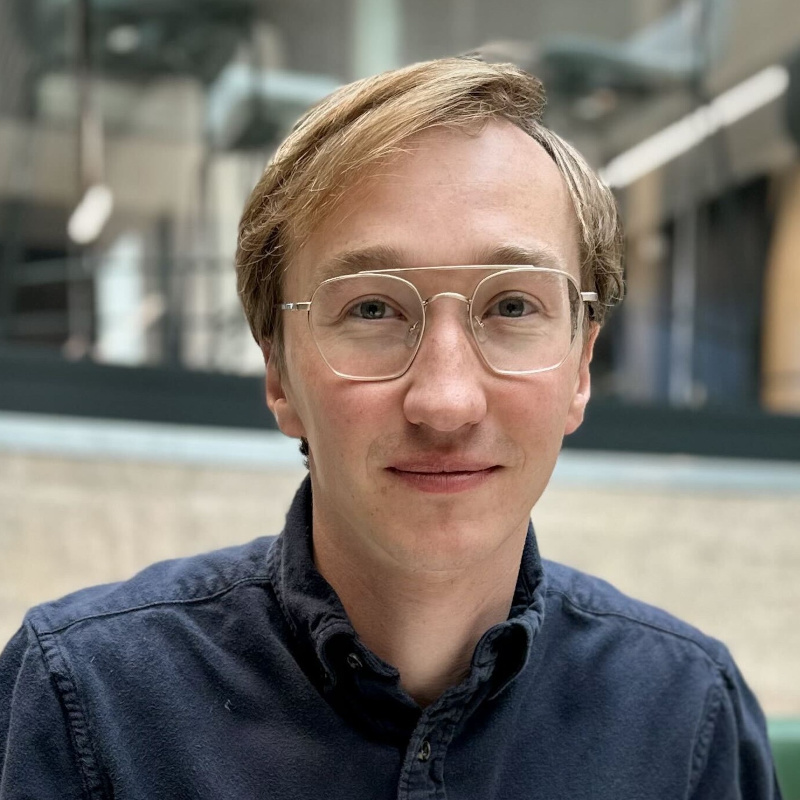
Henry’s work focuses on the earliest stages of childhood cancer, asking a fundamental question: why do some cells with cancer-associated mutations progress to malignancy, while others do not? His team applies cutting-edge spatial DNA and RNA sequencing to mutant cells within their native tissue environments and couples this to functional approaches. This research dovetails with his clinical work as a paediatric pathology registrar at Addenbrooke’s Hospital in Cambridge.
Henry studied medicine at Cambridge through the MB/PhD programme. During his PhD in the Somatic Genomics Programme at the Sanger, supervised by Peter Campbell and Mike Stratton, he led some of the first studies sequencing normal human blood and colon. This work contributed to the discovery that cancer-associated driver mutations are widespread in apparently healthy tissues, reframing cancer as a rare outcome of a common, ongoing process of mutation and selection.
Following his clinical training, Henry began specialty training in pathology, motivated by a desire to understand disease at the cellular level. He was awarded a Junior Research Fellowship at Trinity College Cambridge, during which he carried out postdoctoral research with Sam Behjati in the Cellular Genomics Programme at the Sanger. There, he transitioned into paediatric cancer research and started to develop the experimental and analytical approaches that now underpin his lab’s work on the selective forces shaping mutant cell populations.
My timeline
Appointed Group Leader in the Cellular Genomics programme
Paediatic Pathology subspecialty training
Joined Sam Behjati's lab as a Postdoctoral Fellow, supported by a Trinity College Junior Research Fellowship
Started training in Histopathology, Addenbrooke's Hospital, as an NIHR Academic Clinical Fellow
Awarded MB/BChir; started working as a doctor on the Academic Foundation Programme
Awarded PhD, University of Cambridge