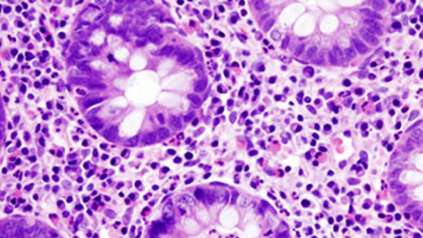
Study of millions of cells reveals new way to understand genetic risk of disease
Scientists have created the most detailed cell map to date showing how genetic variation influences inflammatory bowel disease (IBD), revealing the specific cells and genes that drive the disease.
Published today (3 June) in Nature, the research carried out at the Wellcome Sanger Institute, Open Targets, and Cambridge University Hospitals NHS Foundation Trust (CUH), identifies the key genetic and cellular drivers of IBD risk and demonstrates the power of single-cell approaches to understand the complex nature of human disease.
The findings lay the foundation for the development and repurposing of new treatments across many diseases.
IBD – which includes Crohn’s disease and ulcerative colitis – is characterised by chronic inflammation of the gastrointestinal tract and affects over 4.9 million people worldwide,1 including more than half a million in the UK.2
Inherited changes in DNA are known to play a major role in determining whether someone may be susceptible to IBD. However, translating this knowledge into biological understanding is difficult because over 90 per cent of DNA changes linked to IBD lie outside regions of the genome that code for proteins. These DNA changes are therefore thought to influence the disease by altering how strongly particular genes are switched on or off, known as the gene ‘expression’ level.
However, identifying the specific genes and cell types dysregulated by these DNA changes have proven difficult. This is because most cellular studies of disease analyse whole tissue samples that blend many cell types together, masking effects that only operate in specific cells.
In a new study, researchers at the Sanger Institute, Open Targets, CUH and their collaborators sought to understand whether studying the expression level of genes in individual cell types could better explain how genetic risk contributes to IBD.
The team collected blood and gut samples at Addenbrooke’s Hospital in Cambridge, UK from just over 400 individuals, including 125 people with Crohn’s disease.3 Gut samples were collected from the terminal ileum – the last portion of the small intestine – and the rectum. The terminal ileum and rectum are the most commonly affected sites in Crohn’s disease and ulcerative colitis, respectively.
The researchers generated ‘IBDverse’, the largest single-cell dataset from gut tissue and blood from Crohn’s disease and healthy patients, containing gene expression data from roughly 2.2 million individual cells. They measured the expression level of tens of thousands of genes in each of these cells using a method called single-cell RNA sequencing. They then linked inherited genetic differences to changes in gene expression level and compared these to known genetic risk regions for IBD.
Many genetic effects linked to IBD were found to only appear in specific cell types and are missed when studying whole tissues. The team identified likely effector genes – genes that are most likely to drive disease – at more than half of known genetic regions associated with IBD.
The researchers also found that many genetic effects occurred in immune cells, particularly in dendritic cells,4 which resulted in reduced Notch signalling – a pathway involved in regulating immune responses in the gut.
They also identified genetic effects in a type of cell that covers the body’s internal and external surfaces, known as epithelial cells. Genetic changes linked to IBD dysregulated the expression of Wnt-regulated genes which control crucial cellular functions.5 This leads to reduced tissue renewal that may weaken the gut lining and contribute to IBD susceptibility.
Overall, the study demonstrates the power of single-cell sequencing and genetics to unlock the mysteries of disease. The findings suggest that IBD arises from a combination of immune system dysregulation and failure of the gut lining to repair itself properly.
The study also points to broader implications for drug development. Among the genes identified, the researchers found a potential explanation for why metformin – one of the most widely prescribed drugs for type 2 diabetes – commonly causes gastrointestinal side effects, suggesting that single-cell genetic mapping could help anticipate the tissue-specific effects of existing drugs. Beyond IBD, the findings demonstrate a broadly applicable framework for connecting genetic risk to specific cells and pathways in any disease where relevant tissue can be sampled, with potential applications for conditions including asthma, psoriasis and endometriosis.
“To our surprise, many of the newly nominated effector genes regulate pathways that were previously underappreciated in the context of IBD risk. These associations also accumulated in specific cell types of the gut, such as dendritic cells and gut stem cells, which are not commonly associated with the disease. This work therefore really helps us understand the overall picture of what molecular changes cause IBD, and in which cell types and tissues.”
Dr Bradley Harris, co-first author at the Wellcome Sanger Institute
“The Foundation is pleased to support this important project as part of its genetics initiative. This high-resolution cell map provides more granular information on which pathways are abnormal in different cell types in IBD. Information such as this can guide researchers to disease signals in specific cell types. These data can reveal new mechanisms of disease, and potentially more targeted treatments for patients.”
Dr Alan Moss, Chief Scientific Officer of the Crohn’s & Colitis Foundation, one of the study’s funders
“When we started planning this study, single-cell sequencing projects typically involved tens of individuals. We knew that to have any real power to answer these questions, we would need to obtain tissue samples at a far larger scale, involving hundreds of patients undergoing invasive biopsies specifically for this research. The willingness of those patients to contribute, and the extraordinary effort of the clinical and laboratory teams to collect and process samples at that scale, made this unprecedented science possible.”
Dr Tim Raine, co-senior author and consultant gastroenterologist at CUH
“Genome-wide association studies have told us where in the genome IBD risk resides, but this study tells us which genes these risk variants disrupt and in which cell types this occurs. What’s really exciting about this, in addition to the many lessons we’ve learned about IBD biology, is that the same approach can be used to unlock the biological mysteries of many different diseases. Single-cell sequencing at scale provides a high-resolution view of disease biology, and by combining that with genetic variation, we can now make the insights needed to drive better drug target identification.”
Dr Carl Anderson, co-senior author at the Wellcome Sanger Institute and Open Targets
More information
Notes to Editors
- Vos T, Lim SS, Abbafati C, Abbas KM, Abbasi M, Abbasifard M, et al. Global burden of 369 diseases and injuries in 204 countries and territories, 1990–2019: a systematic analysis for the Global Burden of Disease Study 2019. Lancet. 2020;396:1204–22. doi: 10.1016/S0140-6736(20)30925-9.
- Crohn’s & Colitis UK (2022). ‘New research shows over 1 in 123 people in UK living with Crohn’s or Colitis.’ Available at: https://crohnsandcolitis.org.uk/news-stories/news-items/new-research-shows-over-1-in-123-people-in-uk-living-with-crohn-s-or-colitis [Last accessed: September 2025]
- 296 individuals without IBD and 125 with Crohn’s disease were recruited at Addenbrooke’s Hospital, Cambridge, UK. During routine endoscopy, gastrointestinal biopsies were collected from the rectum and terminal ileum, and blood samples were drawn after the procedure. Terminal ileal biopsies were obtained from 243 individuals without IBD and 119 individuals with Crohn’s disease. Rectal biopsies were collected from 275 individuals without IBD. Whole blood was collected from 95 individuals with Crohn’s disease.
- Dendritic cells are a specialised subset of myeloids cells (immune cells) that develop in the bone marrow. They patrol cells, capture pathogens and present antigens to T cells to initiate immune responses.
- The Wnt-signalling pathways are a group of signalling pathways that begin with proteins that pass signals into a cell through cell surface receptors. The process regulates fundamental biological processes, including cell fate determination, proliferation and migration.
Publication
T. Alegbe et al. (2026) ‘Cell-type-resolved genetic regulatory variation shapes inflammatory bowel disease risk’. Nature DOI: 10.1038/s41586-026-10627-z
Funding
This research was supported in part by the NIHR Cambridge Biomedical Research Centre, Wellcome, The Crohn’s & Colitis Foundation Genetics Initiative and Open Targets.