Genomics Futures Workshop: The Future of Innovative Technologies for Measuring and Engineering Life
Chaired by Dr Mathew Garnett and Dr Leopold Parts
Overview
Aim
The workshop aimed to explore what new tools and technologies are needed to better understand how life works, predict diseases, and develop new medicines. The workshop focussed on the opportunities that using artificial intelligence (AI) and advanced biology techniques presented.
Importance
Understanding and engineering biology could transform healthcare, agriculture, and environmental sustainability. It could lead to faster drug discovery, personalised medicine, and more sustainable ways to produce food and materials.
Listen to our Podcasts discussing this Workshop
Listen directly on this page:
Episode 3 Part 1 – Genomics Futures: AI and Synthetic Biology
Listen to “AI and Synthetic Biology: Part 1” on Spreaker.
Episode 3 Part 2 – Genomics Futures: AI and Synthetic Biology
Listen to “AI and Synthetic Biology: Part 2” on Spreaker.
Full Genomics Futures Podcast series
The Genomics Futures podcast series is available to listen to on Apple Podcasts, Spotify and Spreaker.
New episodes released weekly.
Where are we now and where are we going?
Right now, scientists can collect lots of biological data, but struggle to connect it all meaningfully (for example, linking genes to how organisms behave). AI is helping, but is limited by poor-quality or incomplete data.
We are moving toward:
- Real-time measurement of biological processes inside the human body
- AI systems that can design and run experiments
- More automated and collaborative ways of doing science
Key Challenges
- Not enough high-quality, well-organised data
- Difficulty linking small-scale biology (cells) to whole organisms
- Limits in current DNA-writing technology (speed, accuracy, cost)
- Lack of standardisation and shared systems
- High costs and infrastructure needs for advanced labs
Considering the future
10-year visions
In the next decade, researchers imagine:
- Lab models for all human cell types
- Highly automated labs running thousands of experiments quickly
- AI helping design and interpret experiments in real time
- Faster progress in understanding gene functions
Looking Beyond 2035
Looking further ahead to 2050, the vision is:
- Ability to “write” and build DNA at very large scales
- Creation of complex human tissues or even organs in the lab
- “Digital twins” of humans to simulate health and disease
- Fully AI-driven biology, where experiments can be run remotely by anyone
- Global access to advanced biological tools, regardless of location
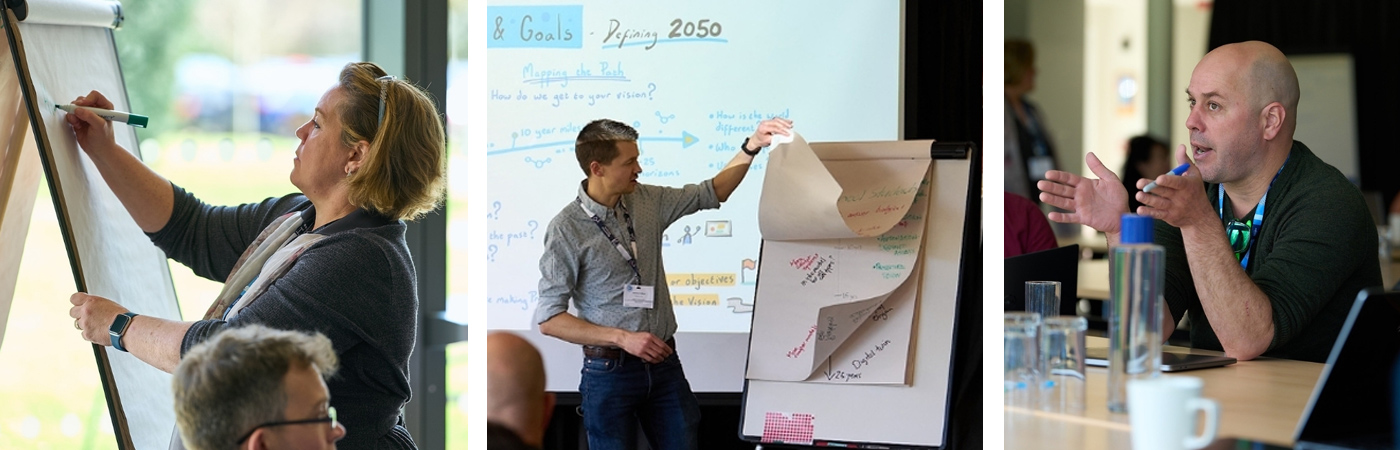
Key discussion themes
- How to scale biology from molecules to whole organisms
- Using AI to guide experiments and discoveries
- Writing and editing DNA more effectively
- Automating research and making it widely accessible
- Learning from nature’s complexity to design better systems
Open Questions
The workshop identified several unresolved challenges:
- How do we gather enough high-quality data to power AI?
- What should we prioritise when designing or editing DNA?
- How do we ensure fair access to these powerful technologies?
- What ethical and safety rules are needed?
- How can we measure progress in a clear and meaningful way?
Conclusion
Biology is entering a new phase where AI, automation, and advanced engineering could dramatically accelerate discovery. However, progress depends on better data, new technologies, and more collaborative and inclusive approaches. If these challenges are addressed, the field could reshape medicine, science, and society over the coming decades.