Bats originated in Europe, largest bat genome and fossil study finds
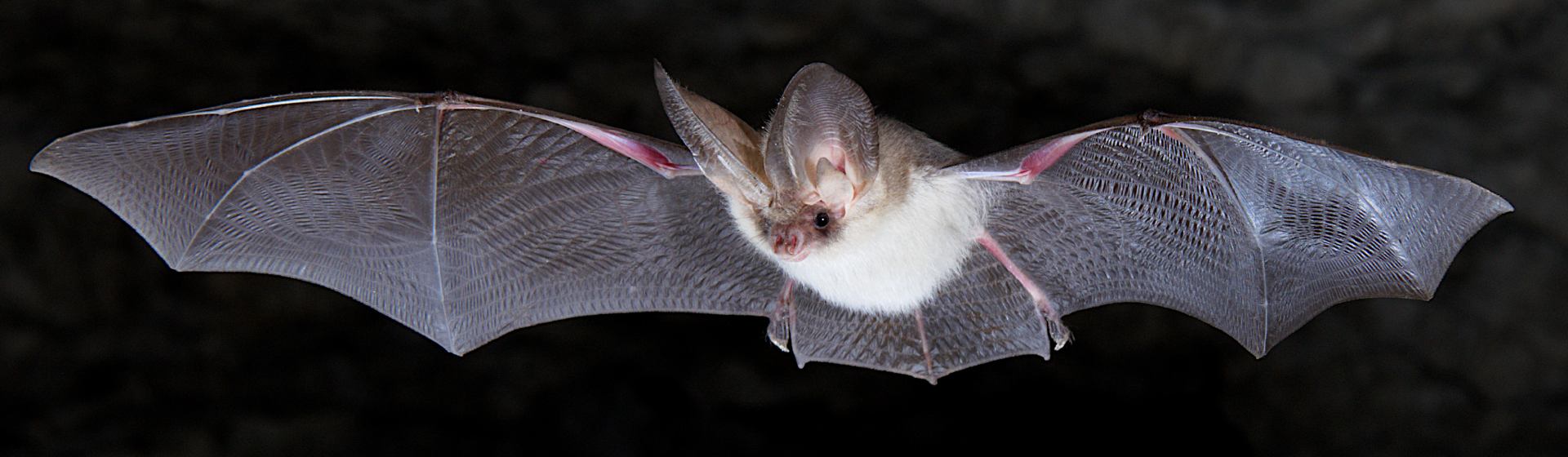
In the largest bat genome and fossil study ever conducted, researchers found that bats most likely arose in Europe, and not Asia, Africa or North America as long assumed. The study also uncovered that echolocation and flight evolved early in bats. The research redraws the bat family tree and resolves debates that have puzzled scientists for decades.
Wellcome Sanger Institute scientists joined an international team of 137 researchers from 64 countries, working together as part of the Bat1K consortium.
The team combined genomic and fossil evidence to show that bats, and thus mammalian flight, most likely originated in Europe around 65 million years ago. They also reconstructed the genome of the ancestor of all living bats for the first time.
These results overturned previous hypotheses proposing Asian, African or North American origins. Their earliest descendants then dispersed into Africa, establishing a Europe-Africa hub from which bats then expanded into Asia, the Americas and Australia.
Published in Nature, the findings lay new foundations for research into how bats resist disease and have long lifespans, with potential relevance to human ageing and disease research.
Bats are among the most extraordinary mammals on Earth. They are the only mammals capable of true powered flight. Most bats orient and hunt in complete darkness using sound alone, known as echolocation. With more than 1,500 species distributed across the globe, bats account for one fifth of all living mammals and play vital roles in maintaining healthy ecosystems by pollinating plants, dispersing seeds and consuming vast numbers of insect pests. Furthermore, many bat species show remarkable resistance to disease and live exceptionally long lives for their size.
Yet despite their extraordinary biology and ecological importance, scientists have struggled for decades to answer some of the most fundamental questions about bat evolution. Where did bats come from? How are the bat families related? When did flight and echolocation emerge? And how did bats evolve the unusual traits that set them apart from other mammals?
In a new study, Sanger Institute scientists and their collaborators in the Bat1K provide answers to many of these long-standing questions.
The team assembled the largest collection of high-quality bat genomes to date, covering 103 species and representing every one of the currently recognised 21 bat families.
They combined them with 44 fossil bats from across the globe to reconstruct the evolutionary history of the world’s only flying mammals.
The team analysed these genomes and fossils using novel methods and revised the bat evolutionary tree, resolving several long-running debates about how the major bat groups are related.
The genomic resource built for this study gives scientists the first robust evolutionary framework to investigate the genes behind unique bat traits. This work could eventually inform human research into ageing, immunity and disease resistance.
Building this dataset required samples collected over decades from bats across the world, including representatives of some of the rarest and most unusual bat families, found in the most remote locations.
Among them are the tiny bumblebee bats of Thailand and Myanmar, widely considered the Earth’s smallest mammal, the remarkable sucker-footed bats of Madagascar, which have suction cups on their wrists and ankles that they use to cling to smooth leaves, and one of New Zealand’s only native mammals, the lesser short-tailed bat, which ‘walks’ along the forest floor using its folded wings as forelegs.
The fossil evidence also provides important clues about another long-standing mystery: when bats first evolved echolocation.
The placement of the fossil bat Vielasia within the oldest branch of the bat family tree indicates that echolocation predates the diversification of modern bats. The finding suggests that two of the defining characteristics of bat biology, echolocation and powered flight, were established near the origin of the group itself, helping explain the extraordinary evolutionary success of bats over the subsequent 65 million years.
The team also reconstructed the genome of the bat ancestor, showing what the first genome of a mammal capable of flight would have looked like.
This now gives scientists a genomic map for how one lineage of mammals evolved powered flight, advanced biosonar, exceptional longevity and unusual disease resistance, and a foundation to trace the genetic basis of these traits with relevance well beyond bats.
“What excited me most was the chance to spotlight the less explored parts of the bat genome – the ‘dark genome’ – and show that these overlooked regions can carry powerful evolutionary signals that help shed new light on bat phylogeny. Being part of such a large international collaboration also made it possible to bring together the genomic resources and expertise needed to ask evolutionary questions at a scale that would be difficult for any one group to achieve alone.”
Dr Yan Liang, author at the Wellcome Sanger Institute
“Bats constantly surprise us. They are one of evolution’s greatest experiments. This extraordinary genomic resource, the culmination of years of international cooperation of Bat1K, is finally allowing us to understand how their remarkable biology evolved.”
Professor Sonja Vernes, Co-founding Director of Bat1K and senior author at the University of St Andrews
“It is extraordinary, after decades of research and conflicting findings, we finally have a robust phylogenetic tree that we can now use to properly understand how bats’ unique traits evolved. We also have the genomes to uncover the molecular basis of these spectacular adaptations and know where the fossil bats fall in this tree.”
Professor Emma Teeling, Co-founding Director of Bat1K, Associate Faculty at the Wellcome Sanger Institute and senior author at University College Dublin
More information
Publication:
Ariadna E. Morales, Yan Liang, et al. (2026) ‘Reference genomes and fossils revise bat family phylogeny and biogeography’. Nature. DOI: 10.1038/s41586-026-11007-3
Funding:
For full funding information, please refer to the publication.
About Bat1K
The Bat1K consortium is an international initiative working to generate and analyse reference-quality genome assemblies for all living bat species. This study represents Phase 1 of the project. See more at www.bat1k.com