

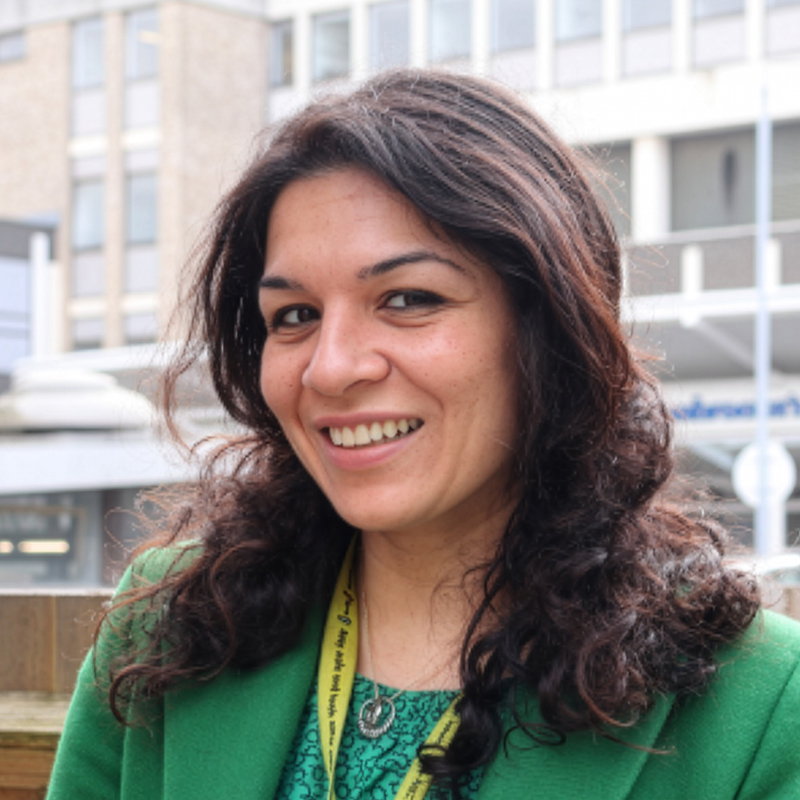
Dr Ayesha Noorani
CRUK Clinician Scientist and Honorary Consultant Upper Gastrointestinal Surgeon, Wellcome Sanger Institute and Addenbrooke's Hospital, Cambridge University Hospital NHS Trust
Cancer is a competitive evolutionary process, yet the genomic rules that govern cancer risk remain poorly understood. My work aims to identify the earliest genomic imprints in histologically normal tissue of the stomach and oesophagus — across both epithelial and non-epithelial compartments — that predispose to or protect against cancer development. By understanding how these early genetic alterations influence tumour initiation long before changes are visible under the microscope, I aim to lay the foundations for future preventative and therapeutic strategies.
Clinically, I am a consultant upper-gastrointestinal surgeon specialising in the treatment of oesophageal and gastric cancers at Cambridge University Hospitals. This area of medicine is deeply personal to me: my uncle died of oesophageal cancer in his early 50s, at a time when few effective treatment options were available. His experience was a major catalyst for my commitment to research in this field.
I completed my PhD in oesophageal cancer in Professor Rebecca Fitzgerald’s laboratory, funded by an independent MRC Research Fellowship, where I investigated cancer evolution using whole-genome sequencing from diagnosis to death. During this time, I established the UK’s first rapid autopsy programme for oesophageal cancer — the Phoenix Study — which demonstrated the power of large-scale, multidisciplinary collaboration in answering clinically meaningful research questions. This work also led to early collaborations with the Sanger Institute, contributing to some of the first studies sequencing normal tissue to define genomic imprints that precede any histological abnormality.
In 2018, I was awarded an NIHR Academic Clinical Lectureship, followed by a Cancer Research UK Clinician Scientist Award, enabling me to continue my research programme at the Wellcome Sanger Institute. I am the first appointed academic surgeon in the Cambridge Oesophago-Gastric Unit and the first female academic surgeon across the Department of Surgery.
Since moving to the Sanger, my group has extended these evolutionary principles to study the stomach and oesophagus when the tissue appears entirely normal. We use low-input, spatially resolved genomic sequencing technologies to map somatic mutations while preserving tissue architecture, allowing us to model how interactions between epithelial and non-epithelial components alter the cancer risk and drive inter-patient variation. Our work also explores these processes in the context of hereditary cancer syndromes, chronic disease and acute injury states, and drug exposures that may alter the somatic mutation landscape.
Our overarching goal is to generate foundational insights into the genetic variants and cellular processes that govern cancer risk, ultimately improving early diagnosis, prevention, and treatment.
My timeline
Honorary Consultant Upper Gastrointestinal and General Surgeon, Addenbrooke's Hospital, Cambridge University Hospitals
CRUK Clinician Scientist, Wellcome Sanger Institute
FRCS, Royal College of Surgeons in England
Visiting Research Fellow, Wellcome Sanger Institute (2020-2023)
NIHR Academic Clinical Lecturer in General and Upper Gastrointestinal Surgery, University of Cambridge (2018-2023)
Specialty Trainee, General Surgery, Addenbrooke's Hospital, Cambridge University Hospitals NHS Foundation Trust (2016-2018)
PhD, Cancer Genomics, University of Cambridge (2013-2016)
MRC Clinical Research Fellow (PhD), Trinity College, University of Cambridge. PhD: Clonal evolution of oesophageal adenocarcinoma. Supervisor: Prof Rebecca Fitzgerald (2012-2016)
Specialty Trainee, General Surgery, Watford General Hospital & West Hertfordshire NHS Trust (2011-2012)
Foundation Programme & Academic Clinical Fellow, General Surgery, Cambridge University Hospitals NHS Foundation Trust (2006-2011)
MBBChir, MA (Cantab), University of Cambridge (2000-2006)