

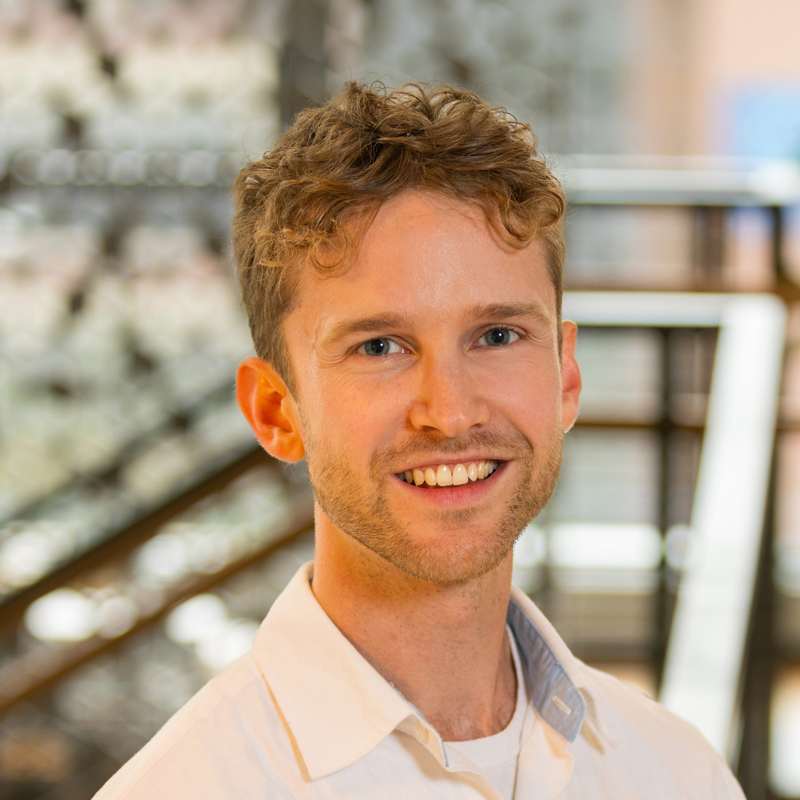
Dr Simon d'Oelsnitz
Group Leader - starting December 2026
I am fascinated by how biology does chemistry. Using a library of enzymes, organisms can make a wild diversity of highly complex molecules using simple precursors in mild conditions. Within the genomes of life hides the solution to a sustainable chemicals industry, the ability to design more effective drugs, and the “code” to liberate humanity from petroleum.
One of the biggest unsolved problems in biology is cracking this code. How does a protein’s sequence encode its ability to bind and transform chemicals? Solving this would unlock two incredible abilities: generation and prediction of genetically-encoded chemistry. First, we could generate designer enzymes and pathways to manufacture any biomolecule. Second, we could predict exactly how any organism perceives and manipulates chemistry from its genome sequence alone. From this perspective, protein biochemistry becomes a data science.
Now, how do we solve it? Recent breakthroughs in protein structure prediction highlight a successful approach: models trained on massive amounts of high quality data. But unlike structure, this data is extremely sparse for biocatalysis and chemical biology largely due to the limits of our analytical tools for measuring chemicals. For example, evaluating 100 enzyme designs can easily take >24 hours. To decode biochemistry, we need a much faster approach.
Unsurprisingly, nature has already evolved an elegant solution to this analytical bottleneck: genetically-encoded sensors. Over the past decade my research has focused on how we can engineer nature’s chemical sensors into high-throughput chemical measurement tools. During my PhD my collaborators and I showed how genetic sensors can generalize across vast chemical space. During my postdoc we showed how they can adopt high specificity to discriminate subtle chemical differences (like chirality), and most importantly, how they can scale the measurement of enzyme function orders of magnitude beyond what modern analytical chemistry offers.
At the Sanger Institute my team combines massive-scale biochemical data generation with predictive modeling to make a meaningful contribution towards understanding how chemistry is genetically encoded. Our work is highly interdisciplinary; we merge techniques in synthetic biology, chemical biology, chemoinformatics, and machine learning to accomplish our goals.
The most rewarding aspect of my career has been the opportunity to work with kind, ambitious, and creative people. Beyond anything else, my number one priority is the success of my team. I encourage everyone to lead their own project to establish independence and project ownership, while also engaging in collaborations to learn how to effectively work in a team. I strongly value creative freedom and intellectual enthusiasm. Have fun doing cool science and the rest will follow.
My timeline
Starting as a Group Leader at the Sanger Institute
Synthetic Biology Postdoctoral Fellow, Harvard Medical School
Visiting researcher, The National Institute of Standards and Technology
Started PhD in Molecular Biology, The University of Texas at Austin
Started Bachelors of Science in Pharmacology, Stony Brook University